
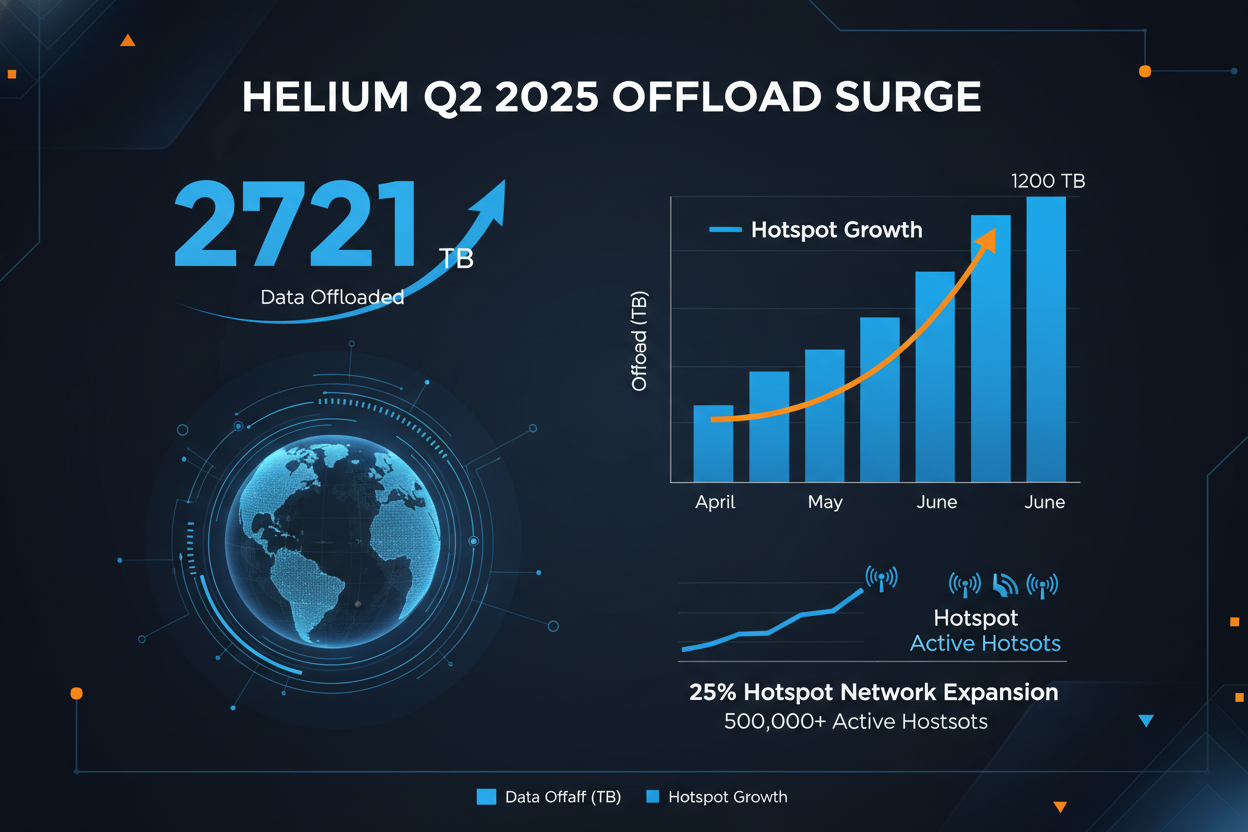
Helium's carrier offload volumes have surged, demonstrating the DePIN wireless network's capacity to handle massive data traffic without proportional increases in hotspot deployments. Recent data shows a 138.5% quarter-over-quarter jump in Q2 2025, totaling 2,721 terabytes offloaded, as partnerships with AT and T and others mature. With HNT trading at $0.8294, up 0.0129% in the last 24 hours, this growth underscores sustainable revenue in decentralized 5G carriers.
Carrier offloads represent real usage: subscribers from traditional telcos seamlessly shift data to Helium hotspots, generating rewards based on throughput rather than speculative mining. This shift from hype to fundamentals is evident in Q4 2025 revenue mixes, where offloads emerged as the core driver, per Helium's official updates.
Dissecting the 138.5% Offload Explosion
Helium's Q2 2025 metrics reveal Helium carrier offloads reaching unprecedented levels. Mobile hotspot counts climbed over 53%, but the real story lies in efficiency: data throughput ballooned without equivalent hardware proliferation. AT and T integration, live since April 2025, allows subscribers to auto-attach to vetted hotspots, offloading cellular strain during peak usage.
T-Mobile customers can offload to its Wi-Fi network, though formal agreements remain nuanced.
This pragmatic scaling aligns with DePIN principles. Traditional carriers deploy costly towers; Helium leverages existing infrastructure. One operator running 12 hotspots reports data transfer rewards from AT and T offload and Helium Mobile subs as the bulk of DePIN wireless revenue growth. Even unselected new hotspots averaged 30GB daily during sampling, hinting at untapped potential in dense areas.
Helium's partnerships now span six carriers: T-Mobile, Movistar, AT and T, Google Orion, and Wefi. Messari's Q3 2025 report flags the Carrier Offload Program as the primary growth engine, evolving from IoT proofs-of-coverage to viable 5G adjuncts.
AT and T and T-Mobile: Pillars of Helium Hotspots Scaling
AT and T's deal exemplifies Helium AT and T T-Mobile integration. Subscribers near selected hotspots automatically connect, easing network congestion without new builds. This validates DePIN's scalability amid regulatory shifts, as noted in recent analyses. Check details on how major US networks use decentralized hotspots.
T-Mobile's role, while less formalized per their statement, powers Helium Mobile's hotspot ecosystem. Revenue splits favor fundamentals: offload data credits hotspots directly, insulating earners from token volatility. Q1 2025 saw initial ramps; by Q2, velocities hit escape from early hype cycles.
| Quarter | Offload TB | Hotspot Growth | Revenue Impact |
|---|---|---|---|
| Q1 2025 | ~1,140 | Baseline | Emerging |
| Q2 2025 | 2,721 | and 53% | Core Driver |
These figures, extrapolated from XT. com and Messari, project sustained Helium hotspots scaling. HNT at $0.8294 reflects measured investor confidence, with 24-hour highs at $0.9296 signaling momentum.
Helium Plus: Zero-Hardware Expansion Accelerates
July 2025's Helium Plus launch revolutionizes participation. Businesses upgrade existing routers to join, bypassing hotspot purchases. This sidesteps capex barriers, targeting public Wi-Fi and enterprise sites for instant coverage gains. No new hardware means pure software-driven decentralized 5G carriers proliferation.
Early adopters report seamless onboarding, with offload eligibility tied to location proofs. Combined with AT and T's footprint, this could double effective reach by Q1 2026 without hardware inflation. Investors eyeing DePIN should note: rewards accrue on usage, not density alone.
Helium (HNT) Price Prediction 2027-2032
Projections based on carrier offload growth trends, DePIN expansion, and $0.8294 baseline in 2026
| Year | Minimum Price | Average Price | Maximum Price | YoY % Change (Avg) |
|---|---|---|---|---|
| 2027 | $1.20 | $2.00 | $4.00 | +141% |
| 2028 | $1.80 | $3.50 | $7.00 | +75% |
| 2029 | $2.50 | $5.00 | $10.00 | +43% |
| 2030 | $3.50 | $7.00 | $14.00 | +40% |
| 2031 | $4.50 | $9.50 | $20.00 | +36% |
| 2032 | $6.00 | $13.00 | $28.00 | +37% |
Price Prediction Summary
Helium (HNT) shows strong upside potential from surging carrier offloads (e.g., 138.5% QoQ in Q2 2025), partnerships with AT&T and T-Mobile, and scalable DePIN infrastructure via Helium Plus, driving average prices from $2 in 2027 to $13 by 2032 amid bull market cycles and adoption growth.
Key Factors Affecting Helium Price
- Carrier offload surge (60% growth, 138.5% QoQ) enabling revenue without new hotspots
- Strategic partnerships with AT&T, T-Mobile, Movistar, and others
- Helium Plus for zero-hardware network expansion
- DePIN wireless adoption and real data transfer rewards
- Market cycles favoring 2027-2028 bull run, regulatory tailwinds, and competition in decentralized infrastructure
Disclaimer: Cryptocurrency price predictions are speculative and based on current market analysis. Actual prices may vary significantly due to market volatility, regulatory changes, and other factors. Always do your own research before making investment decisions.
Such innovations position Helium as a telco complement, not competitor. Revenue evolution charts from Helium's X posts confirm offloads overtaking legacy streams, fostering long-term HNT stability at current levels around $0.8294.
Pragmatists in DePIN will scrutinize whether this offload momentum withstands volatility. Historical patterns show HNT at $0.8294 stabilizing as usage-based rewards decouple from pure speculation. Carrier data credits hotspots per gigabyte transferred, creating a flywheel: more offloads attract more partners, amplifying DePIN wireless revenue growth.
Real-World Proof: Hotspot Operators Weigh In
Ground-level data from operators running multiple units cuts through the noise. One with 12 Helium hotspots breaks revenue into speculative mining versus fundamentals: AT and T offloads and Helium Mobile subscribers dominate, often exceeding 70% of earnings. Even hotspots not yet selected for carrier programs logged 30GB daily during tests, per Reddit discussions. This baseline usage in dense urban pockets signals Helium hotspots scaling organically, without forced deployments.
Such anecdotes align with Messari's quarterly deep dives. Q3 2025 highlights the Carrier Offload Program's maturation, with six partners, T-Mobile, AT and T, Movistar, Google Orion, Wefi, driving terabyte-scale volumes. T-Mobile's nuanced stance, lacking a formal pact per Light Reading, hasn't deterred practical integrations via Helium Mobile.

AT and T subscribers, for instance, latch onto vetted hotspots automatically, per Coinage breakdowns. This passive scaling eases telco capex burdens, positioning Helium as a resilient adjunct for decentralized 5G carriers. Explore Helium hotspots versus traditional 5G towers for IoT resilience comparisons.
Risks in the Offload Flywheel: Data-Driven Mitigations
No expansion lacks friction. Selection criteria for offload-eligible hotspots remain opaque, frustrating new deployers. Carrier sampling favors proven density, leaving fresh units in limbo despite viable throughput. Yet, Helium Plus mitigates this: software upgrades on existing routers democratize entry, potentially flooding networks with capacity by Q4 2026.
| Partner | Integration Date | Offload Contribution Q2 2025 | Scalability Edge |
|---|---|---|---|
| AT and T | April 2025 | High (auto-attach) | Congestion relief |
| T-Mobile | Ongoing via Mobile | Medium | Wi-Fi fallback |
| Movistar | Q1 2025 | Growing | Intl expansion |
This table distills partnership dynamics from Reflexivity Research and Messari. Revenue impacts? XT. com pegs Q2's 138.5% surge to hotspot counts topping 380,000, up 53%. HNT's 24-hour range, low $0.8074, high $0.9296, mirrors this traction at $0.8294.
Investors measure twice before trading: offloads now eclipse IoT in revenue share, per Helium's X evolution charts. Helium Plus accelerates without hardware bloat, targeting airports and enterprises next. See Helium network at airports for venue-specific gains. Fundamentals like these buffer against crypto winters, rewarding patient holders as coverage compounds.
DePIN wireless isn't hype anymore, it's throughput. With carriers leaning in, Helium proves decentralized networks can shoulder real telco loads, sustaining HNT around $0.8294 amid measured gains.




No comments yet. Be the first to share your thoughts!