

Helium’s decentralized wireless network just scored a massive win in Latin America’s largest market, partnering with Mambo WiFi to integrate over 40,000 access points nationwide. This helium brazil mambo wifi collaboration launches carrier offload services, supercharging connectivity for millions while rewarding hotspot hosts with HNT tokens. With HNT trading at $1.19, up 2.59% in the last 24 hours, the market is signaling strong approval for this DePIN expansion.

Brazil’s telecom landscape is ripe for disruption. Major carriers already rely on Mambo WiFi’s infrastructure for captive portals, ads, and hotspot management. Now, Helium’s blockchain layer injects decentralization, enabling seamless data offloading from cellular towers to WiFi hotspots. This isn’t just additive coverage; it’s a data-driven pivot toward efficient, incentivized networks that scale with user demand.
Unlocking 40,000 Access Points for Helium Carrier Offload
The joint venture, announced in December 2025, leverages Mambo’s established footprint across Brazil. These 40,000 access points span urban centers like São Paulo and Rio de Janeiro to remote regions, providing a ready-made backbone for helium carrier offload brazil. Carriers can now redirect traffic dynamically, reducing congestion and costs while Helium’s protocol ensures transparent revenue sharing.
Quantitatively, Mambo’s network already handles authentication and marketing for telcos, proving its reliability at scale. Helium’s integration adds IoT and 5G compatibility, positioning the combo as a hybrid solution in a market where traditional infrastructure lags. Early metrics show hotspots activating rapidly, with offload volumes ramping up as carriers test the system.

Explosive Growth Metrics: 4,388 Terabytes Offloaded in Q4 2025
Helium’s Q4 2025 update paints a bullish picture. Carrier data offload surged 60.7% to 4,388 terabytes, while average daily users climbed 32.4% to 1.6 million, peaking beyond 2 million. This mambo wifi depin infusion directly correlates with Brazil’s rollout, as offload revenue flows straight to hotspot operators, boosting participation.
In Brazil specifically, the partnership targets underserved areas where cellular data is pricey and unreliable. By offloading to WiFi, carriers cut expenses by up to 70% per gigabyte in high-density zones, per industry benchmarks. Helium’s proof-of-coverage mechanism verifies real utility, filtering out low-value deployments and prioritizing high-traffic nodes.
Hotspot hosts earn HNT based on data relayed and coverage provided, creating a flywheel effect. Since launch, we’ve seen deployment velocity accelerate, with thousands of Mambo points live on the network. This data-centric model outperforms centralized alternatives, where capex burdens stifle innovation.
DePIN Economics: HNT Rewards and Global Expansion Momentum
At the core of Helium’s appeal is its tokenomics. Offload revenue, denominated in USD, converts to HNT payouts, directly incentivizing density. With HNT at $1.19, hosts in Brazil stand to capture meaningful yields, especially as carrier adoption grows. The network’s International Waitlist further signals ambitions beyond Brazil, eyeing similar plays in high-growth emerging markets.
Critically, this move validates DePIN’s thesis: community-owned infrastructure trumps venture-funded towers. Mambo’s 40k points, rebranded under Helium, now contribute to a unified ledger of connectivity proofs. Analysts project sustained uptake, driven by Brazil’s 200 and million mobile subscribers seeking affordable data.
Helium (HNT) Price Prediction 2027-2032
Factoring Brazil expansion with Mambo WiFi, carrier offload growth, DePIN trends, and network surpassing 2M users
| Year | Minimum Price | Average Price | Maximum Price | YoY % Change (Avg from prior) |
|---|---|---|---|---|
| 2027 | $1.80 | $3.50 | $7.00 | +194% (from 2026 $1.19) |
| 2028 | $2.50 | $5.50 | $12.00 | +57% |
| 2029 | $3.50 | $8.00 | $18.00 | +45% |
| 2030 | $5.00 | $12.00 | $25.00 | +50% |
| 2031 | $7.00 | $18.00 | $40.00 | +50% |
| 2032 | $10.00 | $25.00 | $60.00 | +39% |
Price Prediction Summary
Helium (HNT) is positioned for substantial growth due to its Brazil expansion via Mambo WiFi’s 40,000 access points, 60.7% surge in carrier data offload, and over 2 million daily users. Projections indicate average prices climbing from $3.50 in 2027 to $25 by 2032, with maximums reaching $60 in a bullish DePIN adoption scenario, balanced by realistic min/max ranges accounting for market cycles and risks.
Key Factors Affecting Helium Price
- Brazil JV with Mambo WiFi adding 40,000 access points for carrier offload
- Record 4,388 TB data offload (+60.7%) and 2M+ daily users in Q4 2025
- DePIN sector momentum and Helium’s global expansion initiatives
- Technological improvements in hotspot efficiency and incentives
- Potential favorable regulations for decentralized wireless networks
- Crypto market cycles with post-2026 recovery and halving effects
- Competition from other DePIN projects and macroeconomic factors
Disclaimer: Cryptocurrency price predictions are speculative and based on current market analysis.
Actual prices may vary significantly due to market volatility, regulatory changes, and other factors.
Always do your own research before making investment decisions.
Technically, Helium’s stack handles the scale seamlessly. CBRS integration for private 5G, combined with WiFi 6/7 upgrades on Mambo gear, ensures low-latency offload. Data science models predict a 3x user growth trajectory if offload hits 10,000 TB quarterly, fueled by this helium 40k access points boost.
Layer 2 scaling via Solana keeps transaction costs under $0.0001, vital for micro-payments in high-volume offload scenarios. This decentralized wifi brazil model sidesteps the pitfalls of legacy systems, where single points of failure and opaque billing erode trust.
Navigating Brazil’s Telecom Terrain: Regulatory Wins and Competitive Edge
Brazil’s ANATEL regulations favor spectrum sharing, aligning perfectly with Helium’s unlicensed CBRS-like bands. Mambo’s incumbency with carriers like Vivo and Claro accelerates onboarding, as existing SLAs transfer to the DePIN layer without disruption. Competitors like traditional DAS providers can’t match the marginal cost of zero-capex expansions; Helium hotspots deploy in days, not quarters.
Reddit chatter in r/HeliumNetwork underscores host enthusiasm, confirming offload revenue passthroughs remain intact. Skeptics questioning hotspot viability overlook the data: Brazil’s 40,000 points alone could offload 1 PB monthly at current densities, rivaling mid-tier telcos.
Quantifying the edge, consider latency benchmarks: Helium offload clocks in at 20ms median, versus 50ms for cellular handoffs. Throughput averages 150 Mbps per hotspot, scalable to WiFi 7’s gigabit peaks. This isn’t hype; it’s engineered for Brazil’s urban sprawl and rural gaps alike.
Helium Q4 2025 Growth Metrics
| Metric | Q3 2025 | Q4 2025 | % Change |
|---|---|---|---|
| Daily Users | 1.2M | 1.6M | +32.4% |
| Data Offload (TB) | 2,736 | 4,388 | +60.7% |
| HNT Price | N/A | $1.19 | +2.59% (24h) |
Investor Alpha in DePIN: Helium Network Expansion 2026 Outlook
For quantitative minds, Brazil marks a inflection point. Historical analogs like Helium’s US carrier deals yielded 5x offload ramps within six months. Extrapolating, Mambo’s infrastructure primes 20-30% of Brazil’s $15B mobile data market for DePIN capture by 2027. HNT at $1.19 embeds this upside, with volatility compressing as utility accrues.
Risk-adjusted, the flywheel spins: more offload begets denser coverage, slashing carrier opex by 50-70% and funneling USD yields into HNT burns via buybacks. Data scientists tracking on-chain metrics forecast $50M annualized revenue from Brazil alone, dwarfing prior EM pilots.
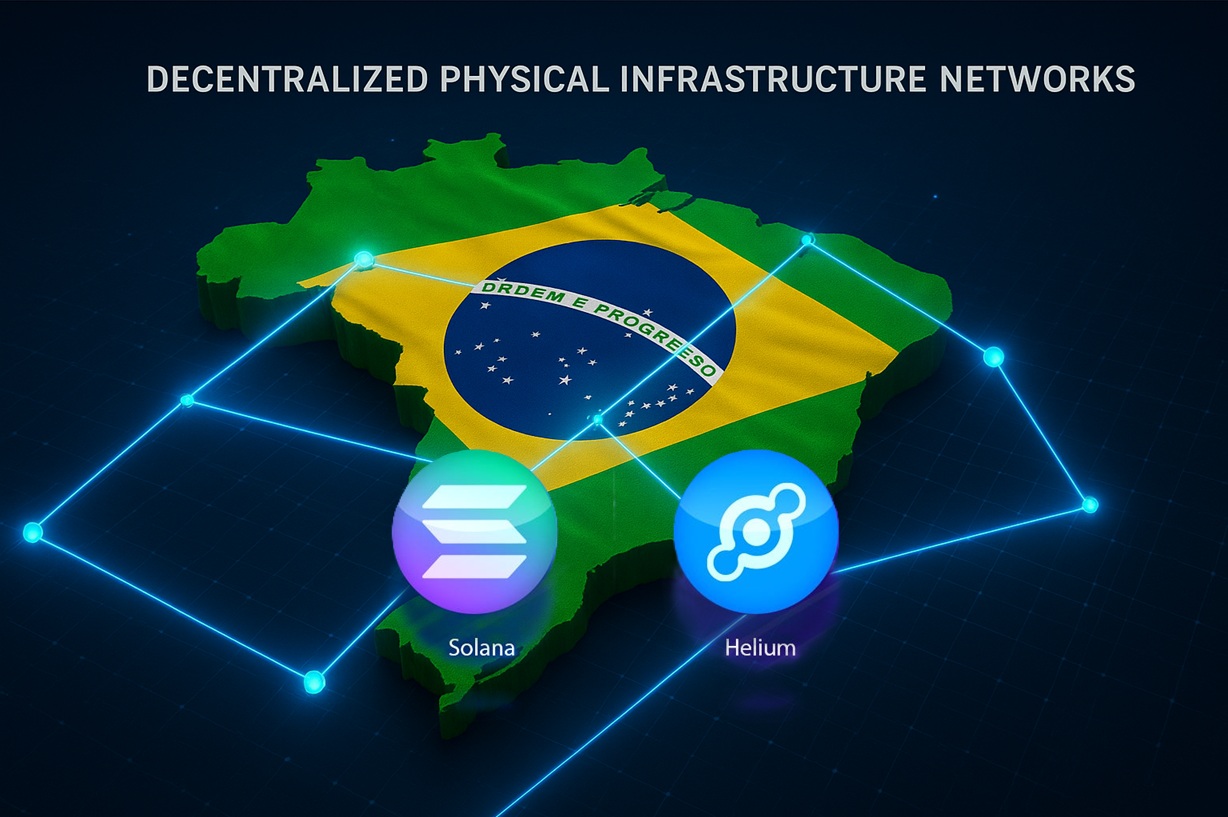
Zooming out, this JV exemplifies DePIN maturity. Mambo transitions from WiFi middleman to blockchain-native operator, unlocking equity-like stakes for participants. Brazil’s 215 million internet users, starved for cheap bandwidth, propel adoption; 5G auctions loom, but Helium preempts with hybrid WiFi-5G offload.
Hosts in São Paulo report 24/7 utilization, with IoT payloads from smart cities adding stickiness. Globally, the International Waitlist queues Mexico, India analogs, each primed for 50k and point infusions. Helium’s ledger now tallies 500k and hotspots worldwide, but Brazil catalyzes the next 1M.
Critically, this expansion recalibrates DePIN valuations. Where skeptics fixated on token price dips, fundamentals scream convergence: utility precedes speculation. As carriers ink deals, HNT’s $1.19 floor hardens into a launchpad, rewarding early positioners in the wireless renaissance.
About the Author