The shift from wired to decentralized wireless
Urban internet service providers have spent decades building a monopoly on the last mile of connectivity, relying on expensive fiber optic cables and copper lines to reach individual homes. This infrastructure-heavy model creates high barriers to entry and limits competition, keeping prices elevated for consumers. DePIN wireless challenges this status quo by replacing physical wires with wireless mesh networks, allowing communities to build their own connectivity layers without waiting for traditional telecom rollouts.
In a mesh network, each node acts as both a user and a repeater, extending the signal range across a neighborhood. This distributed architecture means that adding more users actually strengthens the network rather than degrading it. Fixed wireless access, a core use case for DePIN, enables telecom-free connectivity by linking devices directly to the internet without the need for a dedicated data center line to every household. This shift reduces the capital expenditure required for expansion, making it economically viable to serve dense urban areas that legacy ISPs often neglect due to low profit margins.
The economic pressure on traditional ISPs is intensifying as the cost of maintaining aging copper infrastructure rises. Meanwhile, DePIN projects leverage token incentives to encourage individuals to deploy hardware, effectively crowdsourcing the build-out of internet infrastructure. This decentralized approach not only lowers the cost of entry for new providers but also offers users a more resilient alternative to centralized point-of-failure networks.
How mesh networks replace traditional ISPs
Traditional ISPs rely on a central hub-and-spoke model: data travels from your home to a distant data center and back. DePIN wireless flips this architecture. Instead of a single point of failure, mesh networks distribute connectivity across hundreds or thousands of individual nodes. Each node acts as both a consumer and a provider, creating a redundant, self-healing web that competes directly with monopoly infrastructure.
Decentralized coverage
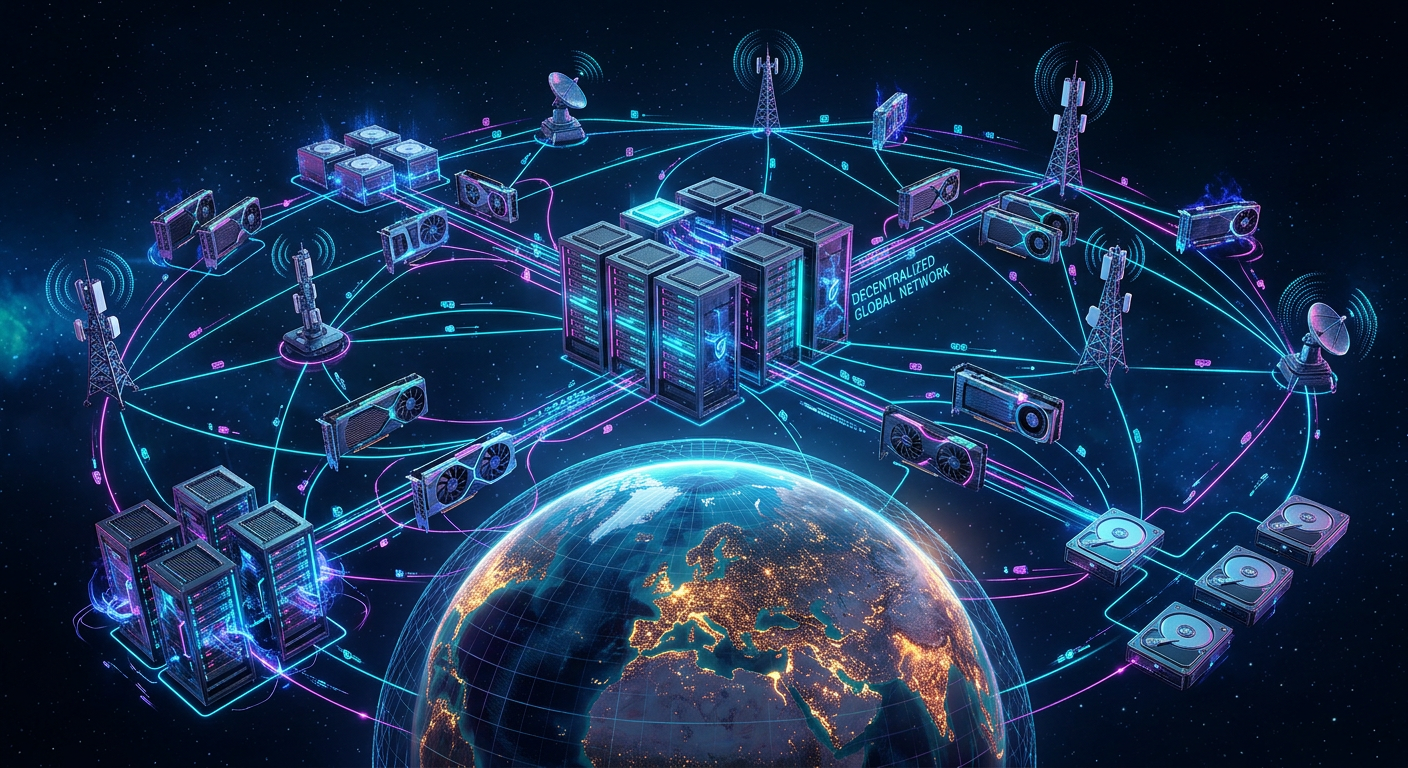
In a DePIN wireless mesh, every device—whether a rooftop antenna or a street-level hotspot—relays data for its neighbors. This creates a coverage area that grows organically as more users join. The network becomes more robust with every new node, unlike traditional ISPs where capacity is capped by the provider’s fixed infrastructure investments. Projects like DAWN use Solana to coordinate these bandwidth shares, allowing users to monetize spare internet access while expanding local coverage.
Competing with monopolies
This decentralized model lowers the barrier to entry for internet access. By leveraging existing hardware and distributed resources, DePIN projects can offer service in areas where traditional ISPs find it unprofitable to lay fiber. The result is a competitive market where connectivity is not dictated by geographic monopolies but by community participation and technical efficiency.
Technical reliability
Mesh networks use dynamic routing algorithms to find the fastest path for data packets. If one node goes offline, traffic automatically reroutes through adjacent nodes. This resilience ensures consistent uptime, a critical factor for both residential users and businesses. As blockchain technology integrates with physical infrastructure, these networks are proving that decentralized systems can match, and often exceed, the reliability of legacy ISPs.
Top DePIN wireless projects in 2026
The DePIN wireless landscape has shifted from experimental pilots to established infrastructure providers. In 2026, the leading projects differentiate themselves through distinct hardware requirements, coverage strategies, and token reward mechanisms. Understanding these differences is essential for anyone evaluating the sector, as the technology stack varies significantly between LoRaWAN, Helium Mobile, and traditional Wi-Fi mesh approaches.
The following table compares the key metrics of the most prominent DePIN wireless networks. These projects represent the current standard for decentralized physical infrastructure, each serving a specific niche in the broader connectivity market.
Helium Mobile
Helium Mobile is currently the most visible DePIN wireless project, leveraging a dense network of 5G Customer Premises Equipment (CPE) devices. By replacing traditional carrier towers with community-deployed hotspots, Helium offers competitive mobile data plans while rewarding hotspot owners with HNT tokens. The project's strength lies in its rapid hardware adoption and the integration of its mobile network with its existing IoT infrastructure, creating a hybrid model that serves both consumer and machine-to-machine use cases.
Helium IoT (LoRaWAN)
Before mobile, Helium established itself as the leader in long-range, low-power wireless connectivity. The network relies on LoRaWAN gateways to connect sensors, trackers, and smart devices over long distances with minimal battery consumption. This segment of the DePIN wireless ecosystem is critical for industrial and agricultural applications, where cellular data is too expensive or power-hungry. The token reward structure here is based on data transfer, incentivizing operators to maintain high-quality signal coverage in underserved areas.
Nebra and Hardware Partnerships
Nebra Hotspot stands out as a primary hardware provider for the Helium ecosystem, ensuring that the physical infrastructure meets strict technical standards for signal integrity. Unlike software-only projects, DePIN wireless requires robust, weather-resistant hardware to function in urban environments. Nebra’s role highlights the importance of supply chain reliability in DePIN; without consistent, high-quality gateways, the network's coverage map remains fragmented and unreliable for end-users.
Market Context
The value of these networks is directly tied to token performance and real-world adoption. Investors and participants should monitor on-chain data and coverage maps rather than relying on static projections. The DePIN wireless sector is volatile, with token prices fluctuating based on network growth and regulatory developments.
The economic engine behind DePIN wireless
Token incentives turn individual users into infrastructure owners. Instead of a single corporation funding cell towers and fiber lines, DePIN wireless networks distribute the cost across a global community. Participants deploy hardware—often small routers or antennas—and earn cryptocurrency rewards for providing coverage or bandwidth. This model lowers the barrier to entry for network expansion while creating a self-sustaining ecosystem where growth is directly tied to participation.
The financial appeal is straightforward: operators buy hardware and earn tokens that often appreciate as the network scales. This creates a flywheel effect. As more nodes join, coverage improves, attracting more users and increasing the value of the network’s token. Projects like Helium, a prominent DePIN wireless example, have demonstrated that this model can build extensive physical networks faster and cheaper than traditional ISPs. Helium notes that this structure allows anyone to bootstrap the network and receive rewards for doing so, effectively crowdsourcing infrastructure development.
However, this model faces volatility risks. Token prices fluctuate, meaning operator revenue can vary significantly. To mitigate this, many networks are moving toward stablecoin rewards or pegging token value to real-world utility. Understanding the current market sentiment for these tokens is essential for evaluating the long-term viability of these networks.
Risks and regulatory hurdles for DePIN
DePIN wireless operates in a regulatory gray zone that traditional ISPs have navigated over decades. The core tension lies in spectrum licensing. Most DePIN mesh networks rely on unlicensed bands like Wi-Fi frequencies to keep hardware costs low and deployment rapid. While this model works for community projects, it faces intense scrutiny from national regulators who view unlicensed spectrum as a shared public resource, not a commercial utility.
In urban environments, the stakes are higher. Regulators worry about interference with critical services, from emergency responder radios to cellular backhaul. The Federal Communications Commission and similar bodies abroad are increasingly monitoring the airwaves. A DePIN wireless network that inadvertently jams a 911 dispatch channel could face immediate shutdown and legal action. This risk makes scaling in dense cities a technical and legal tightrope walk.
Technical scalability adds another layer of complexity. As mesh networks grow, routing packets through hundreds of dynamic nodes becomes computationally expensive. Latency spikes and packet loss are common in large-scale deployments, degrading the user experience. Unlike fiber or cable, where infrastructure is fixed, DePIN wireless must constantly adapt to changing node availability and signal interference from physical obstacles like steel buildings.
The market reacts to these uncertainties. Traditional telecom stocks like Verizon (VZ) often see volatility when DePIN announcements threaten incumbent market share. Investors weigh the potential disruption against the regulatory headwinds. Until a clear legal framework emerges, DePIN wireless projects must balance innovation with compliance, often treating regulatory approval as a feature rather than an afterthought.
No comments yet. Be the first to share your thoughts!