
The decentralized wireless sector is experiencing a paradigm shift in 2025, with the Helium Network at the forefront of this transformation. Leveraging a unique fusion of blockchain, 5G, and IoT technologies, Helium has evolved from an experimental network to a robust global infrastructure layer. The numbers are striking: as of November 23,2025, Helium boasts over 1.2 million hotspots worldwide, including more than 25,000 active 5G transmitters. This growth is not just about scale - it’s about real-world utility and adoption across telecom and IoT use cases.
Decentralized Wireless Adoption: Surpassing Legacy Models
Traditional telecom giants have long dominated wireless connectivity through centralized infrastructure and opaque pricing. Helium’s decentralized approach disrupts this paradigm by incentivizing individuals and small businesses to deploy hotspots, collectively building a user-owned network. Strategic partnerships have accelerated this model: in April 2025, AT and T integrated with the Helium Network, enabling seamless data offloading and expanding coverage for millions of users. Shortly after, Movistar (a Telefónica subsidiary) embedded Helium into its Mexican 4G/5G services, unlocking decentralized access for over 2.3 million subscribers.
This collaborative model has yielded impressive results. By Q4 2024, Helium’s network had transferred more than 576 terabytes of offloaded data from major U. S. carriers, marking a staggering 555% quarter-over-quarter increase. By Q2 2025, that figure soared to 2,721 terabytes ( and 138.5% QoQ). These metrics underscore that DePIN wireless adoption is not theoretical - it’s measurably disrupting legacy networks today.
The Power of Integration: 5G Meets IoT on Solana
The foundation of this surge lies in Helium’s technical architecture and its migration to Solana in early 2023. The integration of LoRaWAN-based IoT hotspots with high-speed 5G transmitters creates a multi-layered mesh capable of servicing everything from low-power sensors to bandwidth-intensive mobile devices. As detailed in our deep dive on Helium’s role in powering decentralized 5G for IoT applications, this hybrid approach enables both extensive coverage for smart city deployments and robust capacity for consumer mobile traffic.
User metrics reinforce the platform’s traction: by early 2025 the network was handling nearly 29 terabytes of data per day, with daily active users surpassing 867,000. Meanwhile, signups for Helium Mobile surged by 94.1% in Q2 2025, rising from just over 160,000 to more than 311,000 accounts - driven by affordable plans and growing mainstream awareness.
Tokenomics and Incentives: HNT Price Action Reflects Utility Growth
The incentive structure underpinning hotspot deployment remains central to Helium’s flywheel effect. As the network scales utility through real-world telecom partnerships and IoT integrations, demand for HNT tokens increases proportionally with usage-driven rewards distribution.
Current Market Snapshot:
- HNT Price: $1.77 (as of November 23,2025)
- MOBILE Token: Utility surging alongside new carrier partnerships and user onboarding trends
- Total Hotspots: Over 1.2 million worldwide; >25k active on-ramps for decentralized mobile data
- User Growth: Daily actives now top 867k; Mobile account signups nearly doubled QoQ in Q2 '25
This direct correlation between network activity and token economics is attracting both retail investors seeking alpha in the DePIN sector as well as institutional players looking for scalable alternatives to legacy telecom infrastructure.
Helium (HNT) Price Prediction 2026-2031
Forecast based on current adoption rates, 5G/IoT integration, and market dynamics as of Q4 2025
| Year | Minimum Price (Bearish) | Average Price (Base Case) | Maximum Price (Bullish) | Potential % Change (Avg YoY) | Key Scenario |
|---|---|---|---|---|---|
| 2026 | $1.30 | $2.10 | $4.00 | +18.6% | Continued 5G/IoT adoption; moderate crypto recovery |
| 2027 | $1.50 | $2.90 | $5.80 | +38.1% | Major carrier partnerships expand; broader IoT use cases |
| 2028 | $1.85 | $3.85 | $7.20 | +32.7% | Global hotspot growth; new enterprise integrations |
| 2029 | $2.10 | $4.60 | $8.40 | +19.5% | Regulatory clarity; increased adoption in emerging markets |
| 2030 | $2.30 | $5.30 | $10.00 | +15.2% | Matured network utility; competition intensifies |
| 2031 | $2.00 | $4.80 | $9.00 | -9.4% | Market consolidation; tech advancements vs. saturation |
Price Prediction Summary
Helium (HNT) is poised for steady growth through 2030, driven by its real-world utility in decentralized 5G and IoT networks, expanding global partnerships, and surging user adoption. Average price projections suggest a robust uptrend, though volatility remains due to broader crypto market cycles and competition. The network’s unique integration of Web3 infrastructure and telecom utility could support further upside, especially if regulatory and technical milestones are met. However, a potential market saturation and heightened competition could moderate growth post-2030.
Key Factors Affecting Helium Price
- Global expansion of 5G and IoT use cases via Helium’s decentralized infrastructure
- Strategic partnerships with major carriers (e.g., AT&T, Movistar) driving network effect
- Sustained growth in hotspot deployment and daily network usage
- Ongoing migration and adoption on the Solana blockchain, improving scalability
- Crypto market cycles and macroeconomic trends influencing investor sentiment
- Potential for regulatory clarity or hurdles in key jurisdictions
- Increased competition from both decentralized and traditional telecom providers
- Evolution of hotspot rewards and incentive models impacting token demand
Disclaimer: Cryptocurrency price predictions are speculative and based on current market analysis. Actual prices may vary significantly due to market volatility, regulatory changes, and other factors. Always do your own research before making investment decisions.
What sets Helium apart in 2025 is its ability to bridge the gap between theoretical promise and operational reality. The exponential increase in data offloading: from 576 terabytes in late 2024 to 2,721 terabytes by Q2 2025, reflects not just network growth, but genuine utility delivered to end users and telecom partners. This surge has been catalyzed by a robust incentive model: hotspot operators are rewarded with HNT and MOBILE tokens directly proportional to their network contributions, aligning economic incentives across all stakeholders.
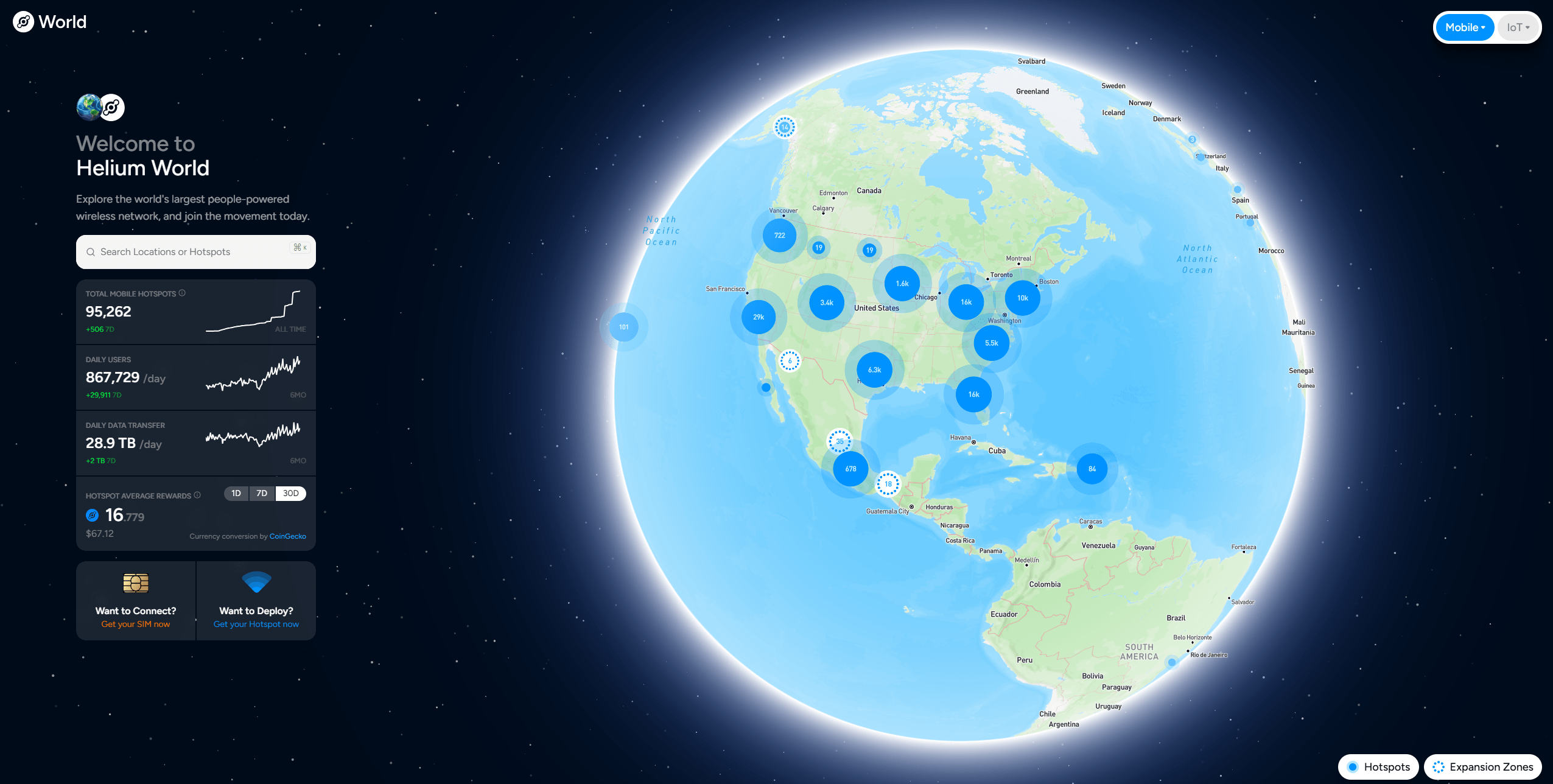
For investors and network participants, Helium’s current price of $1.77 for HNT underscores a market that is increasingly pricing in real-world adoption and long-term sustainability. Unlike speculative projects, Helium’s tokenomics are grounded in measurable usage metrics, active hotspots, data transferred, daily users, that provide a transparent foundation for valuation. The recent halving event has introduced supply-side pressure, but this has been offset by sustained demand from new telecom integrations and IoT deployments.
Beyond the Hype Cycle: Real-World Deployments and User Impact
The impact of Helium’s decentralized wireless model is now tangible across multiple verticals. In smart cities, LoRaWAN hotspots provide cost-effective connectivity for environmental sensors, asset tracking, and critical infrastructure monitoring. For mobile users, the integration with major carriers like AT and T means seamless connectivity at lower costs, a direct challenge to legacy pricing models.
This dual-pronged approach, serving both massive IoT deployments and consumer mobile traffic, is unique within the DePIN landscape. It positions Helium as a foundational layer for the next generation of wireless infrastructure, capable of scaling as new use cases emerge. The ongoing partnership momentum (with Movistar in Mexico and AT and T in the US) signals growing institutional confidence in decentralized models.
Looking Forward: Challenges and Strategic Opportunities
Despite remarkable progress, challenges remain. Regulatory uncertainty around spectrum sharing and decentralized ownership can introduce friction as Helium expands into new markets. Additionally, while IoT adoption has lagged behind infrastructure deployment historically, recent surges in smart device onboarding suggest this gap may close rapidly as enterprises realize the cost advantages of decentralized coverage.
The next phase will likely focus on deepening integrations with traditional carriers while fostering grassroots developer ecosystems around open wireless APIs. As more cities embrace connected infrastructure, from traffic management to energy grids, the addressable market for decentralized wireless only grows larger.
If you’re watching the evolution of wireless technology or seeking exposure to disruptive infrastructure plays, Helium’s trajectory is impossible to ignore. Its blend of technical innovation, user-driven growth metrics, and strong institutional partnerships make it a bellwether for where DePIN, and indeed all connectivity, may be heading next.




No comments yet. Be the first to share your thoughts!