How community networks replace legacy towers
Traditional wireless infrastructure operates on a centralized capital expenditure model. Carriers fund the construction, maintenance, and energy costs of high-tower base stations, recouping these investments through subscriber fees. Decentralized Physical Infrastructure Networks (DePIN) invert this structure. In a DePIN wireless model, the infrastructure is owned and operated by individual users rather than a single corporate entity. This shift transforms passive consumers into active node operators who earn tokens for providing coverage.
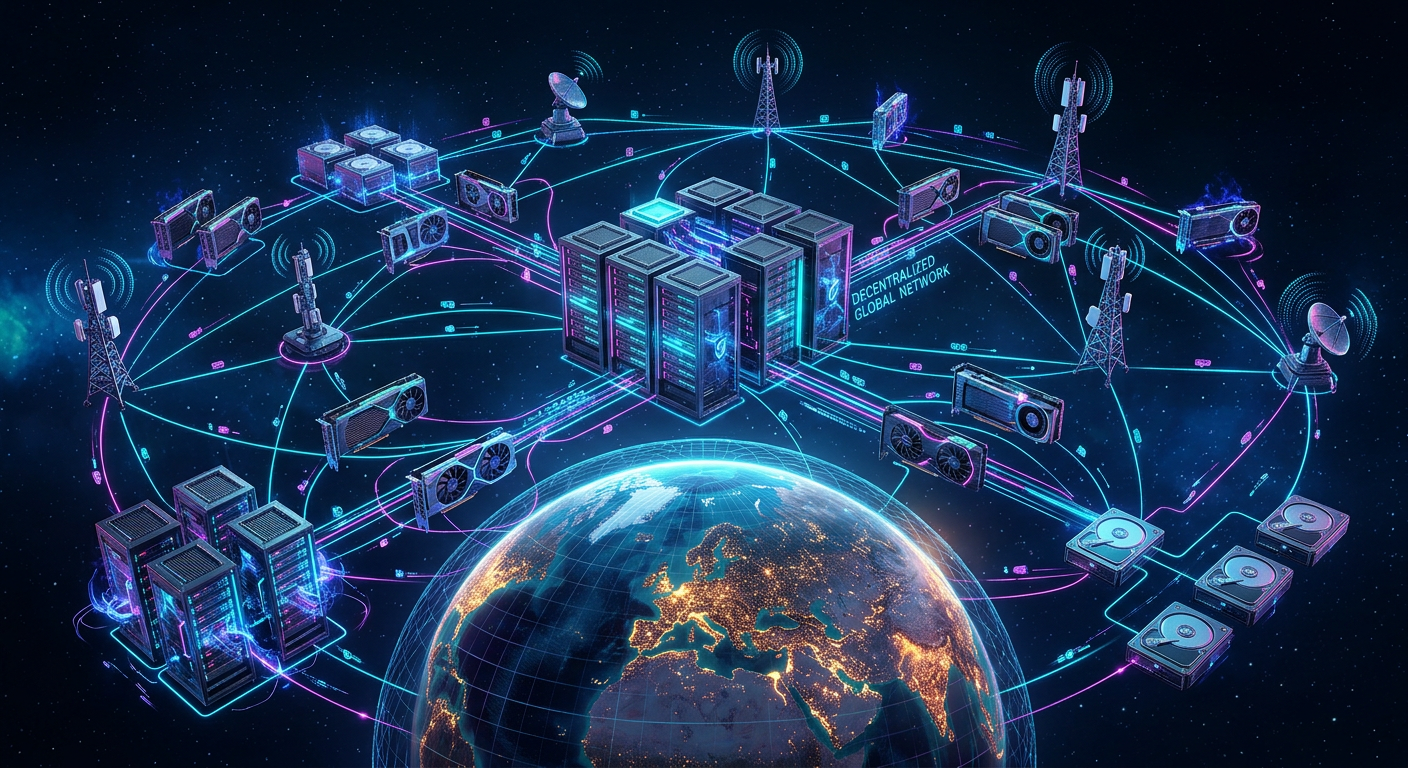
The mechanism relies on distributed hardware. Instead of a monopoly on spectrum and tower sites, DePIN projects utilize a mesh of smaller, accessible devices—often consumer-grade routers or specialized antennas—installed in homes and businesses. These nodes connect to the network, relaying data and earning cryptocurrency rewards for their uptime and bandwidth contribution. This model reduces the barrier to entry for network expansion, allowing coverage to grow organically where users are willing to deploy hardware.
This structural difference creates a distinct economic dynamic. Traditional carriers face high fixed costs and regulatory hurdles for each new tower. DePIN projects distribute these costs across a global network of participants. The result is a scalable infrastructure that can expand rapidly without the heavy capital burden typical of legacy telecom. However, this model also introduces complexity in network management and quality assurance, as the reliability of the service depends on the consistency of thousands of independent operators.
The transition from centralized capex to distributed user ownership is not merely a technological upgrade; it is a reconfiguration of market power. By tokenizing the provision of wireless service, DePIN projects create a liquid market for infrastructure. This allows for real-time pricing of bandwidth and coverage, potentially leading to more efficient resource allocation than the static pricing models of traditional carriers. As the network matures, the reliability and speed of these community-owned networks will determine their viability against established telecom giants.
Helium Mobile leads the decentralized 5G race
Helium Mobile has emerged as the primary case study for community-owned wireless infrastructure, leveraging the Helium Network’s existing LoRaWAN coverage to offer subsidized cellular service. By integrating with major carriers, the network allows users to access 5G data while simultaneously earning HNT tokens for coverage contributions. This model shifts the traditional capital expenditure burden from a single telecom operator to a distributed network of hotspot owners, creating a hybrid public-private utility structure.
Market Position and Tokenomics
The economic model relies on the HNT token to subsidize data costs, effectively lowering the barrier to entry for consumers while incentivizing hardware deployment. As the network expands, the value accrual mechanism ties user growth directly to token demand. Recent market analysis indicates that this dual-utility structure—providing both connectivity and financial yield—has positioned Helium as a leader in the DePIN sector, distinguishing it from pure storage or compute networks.
| Feature | Helium Mobile | Traditional Carrier | Pure DePIN |
|---|---|---|---|
| Infrastructure Ownership | Community | Corporation | Community |
| Data Subsidies | HNT Earnings | Included in Plan | N/A |
| Hardware Requirement | Optional Hotspot | None | Required Node |
| Network Expansion | Crowdsourced | Corporate CapEx | Crowdsourced |
Price Action and Sentiment
Market sentiment for Helium Mobile is closely tied to the performance of the HNT token. The following chart illustrates recent price action and trading volume, reflecting investor interest in the network's expansion milestones.
Other Key Players in Wireless Mesh Networks
While community-owned 5G dominates the current narrative, the broader DePIN wireless landscape includes several specialized mesh and IoT networks. These projects address different segments of the physical infrastructure market, ranging from low-power sensor data to decentralized compute for AI training.
Helium (HNT)
Helium remains the most established player in the wireless DePIN space, originally launching with a LoRaWAN (Long Range Wide Area Network) protocol for IoT devices. The network transitioned to the Solana blockchain to improve transaction throughput and reduce costs. Unlike 5G-focused projects, Helium prioritizes low-bandwidth, long-range connectivity for sensors and trackers, making it a foundational layer for industrial IoT rather than consumer mobile data.
APhone (APH)
APhone represents a direct competitor in the consumer wireless sector, offering a mobile network alternative to traditional carriers. The project focuses on providing affordable, community-backed mobile coverage in underserved areas. By leveraging a token-based incentive model, APhone aims to expand coverage faster than legacy infrastructure can, though its adoption metrics remain significantly smaller than the major 5G initiatives.
Render Network (RNDR)
Render Network operates in the adjacent compute lane, providing decentralized GPU power for graphics rendering and AI workloads. While not a wireless connectivity provider, its infrastructure supports the backend processing required for many DePIN applications. The network's growth highlights the increasing demand for distributed computing resources, which often complements wireless data collection networks.
Comparison of Wireless DePIN Projects
The following table compares key metrics for the primary wireless DePIN projects, highlighting their distinct technological approaches and market positions.
| Project | Core Technology | Primary Use Case | Adoption Stage |
|---|---|---|---|
| Helium | LoRaWAN / Solana | IoT Sensors & Trackers | Mature |
| APhone | Mobile Mesh | Consumer Wireless | Early Growth |
| Render Network | Decentralized GPU | Compute & AI | High Growth |
These secondary players demonstrate that DePIN is not a monolithic trend but a collection of specialized infrastructures. Investors and analysts should evaluate each project's specific technological moat and adoption curve rather than treating the entire sector as a single asset class.
Investment risks and regulatory hurdles
Decentralized Physical Infrastructure Networks (DePIN) sit at the intersection of crypto speculation and heavy physical regulation, creating a volatile investment environment. While the model shifts ownership from centralized corporations to community participants, it does not shield investors from the structural risks inherent in both sectors. The most significant barrier to entry is not technological, but legal: navigating the fragmented regulatory landscape of telecommunications.
In the United States, the Federal Communications Commission (FCC) enforces strict rules on spectrum usage. DePIN wireless projects must operate within licensed bands or adhere to unlicensed spectrum regulations (such as CBRS or 5GHz ISM bands). Missteps here can lead to severe fines or forced shutdowns. For global projects, the International Telecommunication Union (ITU) sets standards that national bodies adopt, meaning a compliant network in one country may be illegal in another. Investors must scrutinize whether a project has obtained the necessary licenses to operate hardware in its target markets, rather than relying on vague "global coverage" claims.
Beyond regulation, token volatility poses a direct threat to network viability. DePIN projects often use tokens to incentivize hardware deployment, but these tokens are subject to the same market swings as other crypto assets. If the token price drops sharply, the economic incentive for node operators may vanish, leading to hardware abandonment and network degradation. This creates a feedback loop where poor token performance reduces infrastructure quality, which further depresses token value.
To monitor these financial metrics, investors should track the performance of major DePIN tokens alongside traditional market indicators. The following widgets provide real-time data for key assets in the sector.
No comments yet. Be the first to share your thoughts!