In the buzzing world of decentralized IoT networks, Helium's LoRaWAN implementation stands out as a game-changer, powering low-cost, crowd-sourced coverage that's reshaping how we connect sensors across vast distances. With HNT trading at $1.08 - up 3.25% in the last 24 hours - the network's momentum feels palpable. But when pitted against WiFi for IoT applications, questions arise: does Helium LoRaWAN's long-range promise hold up against WiFi's ubiquity, especially as WiFi HaLow enters the fray? This DePIN wireless comparison dives into range, cost, and power efficiency to help you decide for your next IoT range cost efficiency project.
Range Realities: Covering Ground in IoT Deployments
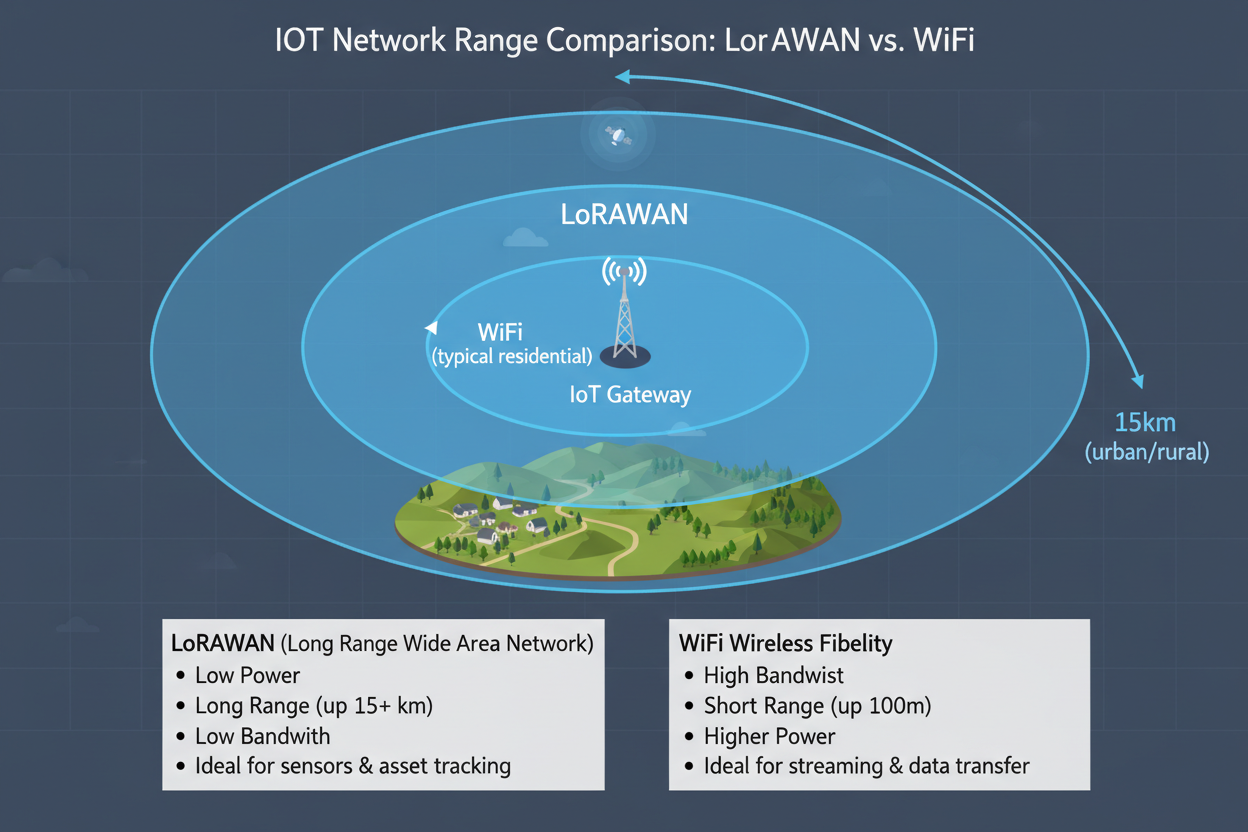
Picture this: you're deploying sensors across a sprawling farm or monitoring air quality in a dense urban sprawl. Range becomes king. Helium LoRaWAN shines here, leveraging the 900 MHz ISM band for signals that stretch up to 15 km in rural open spaces and 2-5 km even in cities. Factors like antenna gain, mounting height, and line-of-sight play huge roles, but hotspots deliver reliable, low-power reach that's hard to beat.
WiFi, on the other hand, sticks closer to home. Standard setups manage 20-50 meters indoors, fine for a smart home but laughable for wider IoT needs. Enter WiFi HaLow, the 802.11ah contender pushing outdoors to about 1 km with sub-1 GHz frequencies. It's a step up, outperforming LoRaWAN in bandwidth-heavy spots, but for true LoRaWAN vs WiFi IoT range battles, Helium pulls ahead where distance defines success - think smart agriculture or environmental monitoring.
Helium's genius lies in its decentralized model: anyone can deploy a hotspot, expanding coverage organically. No central provider dictating limits.
Helium LoRaWAN vs WiFi for IoT Device Monitoring
| Feature | Helium LoRaWAN | WiFi | Advantage |
|---|---|---|---|
| Range | Up to 15 km rural / 2-5 km urban 📡 | 20-50 m indoor / ~1 km HaLow | LoRaWAN ✅ |
| Power Efficiency | Years on single battery 🔋 | Days/weeks (higher consumption) | LoRaWAN ✅ |
| Cost | Single gateway serves thousands; lower for large-scale | Router/access point per area; infrastructure costs | LoRaWAN for scale ✅ |
| Scalability / Network Model | Decentralized hotspots; serves massive deployments | Centralized; limited by infrastructure | Helium LoRaWAN ✅ |
| Revenue Model | Hotspot owners earn HNT ($1.08) via decentralized network | N/A (centralized) | Helium LoRaWAN ✅ |
| Data Rate | 0.3-50 kbps (low, sporadic data) | 150 kbps - Mbps (higher bandwidth) | WiFi for high-data needs |
Cost Considerations: Gateways vs Existing Infrastructure
Money talks in large-scale IoT. LoRaWAN networks like Helium operate in unlicensed bands, dodging spectrum fees that plague cellular alternatives. Yet, the upfront hit comes from gateways - think $500 and per unit for Helium hotspots, plus antennas and setup. For massive deployments, though, costs plummet: lower hardware needs per device and no recurring carrier bills make it a winner, as CHOOVIO notes for scaled operations.
WiFi flips the script. Leverage ubiquitous routers and access points already in buildings, slashing new infrastructure spends. WiFi HaLow slips into existing ecosystems seamlessly, ideal if you're retrofitting warehouses or offices. But scale up to city-wide IoT? WiFi demands more repeaters, inflating costs, while Helium's peer-to-peer growth keeps it lean.
Opinion time: for bootstrapped decentralized IoT networks, Helium LoRaWAN's model - earn HNT by providing coverage - turns cost into incentive. At $1.08 per token, hotspot returns look enticing amid network growth.
Helium LoRaWAN vs. Wi-Fi: Key Comparison for IoT
| Aspect | Helium LoRaWAN | Wi-Fi |
|---|---|---|
| Range | Up to 15 km rural, 2-5 km urban | 20-50 m indoor (Traditional); ~1 km outdoor (HaLow) |
| Cost | Unlicensed bands (no fees), requires gateways & infrastructure | Widely available infrastructure, easier integration (esp. HaLow) |
| Power Efficiency | Ultra-low; years on single battery | Higher draw (Traditional); improved but > LoRaWAN (HaLow) |
| Data Rate | 0.3-50 kbps (low, sporadic data) | Up to Mbps (Traditional); 150 kbps-Mbps (HaLow) |
Power Play: Sustaining IoT Devices Long-Term
Battery life isn't just a feature; it's the lifeline for remote IoT. LoRaWAN was built for this, sipping power so sensors last years on AA batteries. Helium hotspots amplify it, enabling deployments in hard-to-reach spots without constant swaps - perfect for military-grade reliability or wildlife trackers, as ResearchGate studies highlight.
Traditional WiFi guzzles energy, draining packs in hours for always-on chatter. HaLow dials it back with efficient protocols, but still lags LoRaWAN's ultra-low draw. Seeed Studio sums it: LoRa trades speed for stamina, trouncing WiFi and cellular in power-thrifty scenarios.
In Helium's ecosystem, this efficiency fuels adoption. Devices transmit sporadically, conserving juice while blockchain rewards coverage providers. If your IoT vision spans batteries over bandwidth, Helium LoRaWAN dominates.
Helium hotspots in the 900 MHz band extend this edge, creating a web of coverage that's both resilient and rewarding for operators. Real-world tests from Rfwel Engineering confirm: with smart antenna choices and elevation, LoRaWAN crushes WiFi in power-starved, far-flung setups.
Data Rates: Balancing Speed and Sparsity in IoT
Not every IoT job needs a firehose of data. Helium LoRaWAN thrives on sparse transmissions - think soil moisture checks every hour or asset trackers beeping locations. Data rates hover between 0.3 kbps and 50 kbps, optimized for tiny payloads over distance. It's a deliberate trade-off: endurance over express, as Seeed Studio points out when stacking LPWAN against bandwidth hogs like WiFi.
WiFi flips that equation. Standard flavors pump out Mbps for video feeds, voice, or real-time analytics in factories. WiFi HaLow tempers it to 150 kbps-8 Mbps while keeping range respectable, shining in IP-native apps with lower latency. Data Alliance cheers HaLow for outpacing LoRaWAN where security and throughput matter more than marathon battery life. But for most sensor networks? LoRaWAN's restraint avoids network congestion, letting Helium scale without choking.
Here's my take: if your IoT fleet sends megabytes, pivot to WiFi. For the 80% of deployments sipping data droplets, Helium LoRaWAN's efficiency turns constraints into strengths, all while blockchain tallies micro-rewards in HNT at $1.08.
Detailed Specs Comparison: Helium LoRaWAN vs. WiFi HaLow
| Specification | Helium LoRaWAN | WiFi HaLow |
|---|---|---|
| Range | 15 km rural, 2-5 km urban | 1 km outdoor |
| Power Efficiency | Ultra-low: years on single battery | Moderate: better than traditional WiFi, but higher than LoRaWAN |
| Data Rate | 0.3-50 kbps | 150 kbps-8 Mbps |
| Cost | Gateways ~$500, unlicensed spectrum | Leverages existing WiFi infrastructure, lower deployment in covered areas |
| Frequency Band | 900 MHz ISM (unlicensed) | Sub-1 GHz (unlicensed) |
| Ideal Use Cases | Smart agriculture, environmental monitoring, smart cities | High-bandwidth apps like video surveillance, real-time control |
Tailored Use Cases: Picking Winners for Your IoT Vision
Smart farming screams LoRaWAN. Sensors across acres track irrigation or livestock without a repeater army, powered by Helium's crowd-sourced net. Environmental watches in wilds or cities? Same story - low power and epic range win, as Particle contrasts with cellular bloat.
WiFi owns indoor intensity: warehouses with camera surveillance, robotic arms needing instant commands, or office automation. HaLow bridges to outdoor lots or campuses, per top-electronics. com insights, where WiFi's ecosystem plug-and-play slashes setup time.
Helium adds DePIN magic. Fully LoRaWAN-compatible per Semtech, it fuses blockchain incentives with military-proven robustness from ResearchGate studies. Deploy a hotspot, earn from data relayed - a revenue loop WiFi can't match. At $1.08 HNT with a 3.25% 24-hour bump (high $1.10, low $1.02), network health signals investor appetite for this decentralized IoT networks play.
Helium LoRaWAN vs WiFi for IoT: Range, Cost, Power Efficiency & Compatibility
| Metric | Helium LoRaWAN | WiFi | Advantage |
|---|---|---|---|
| Range 🏔️ | Up to 15 km rural, 2-5 km urban | 20-50 m indoor, ~1 km (HaLow) | Helium LoRaWAN ✅ |
| Cost 💰 | Unlicensed bands, cost-effective for large-scale deployments | Leverages existing infrastructure, simpler in WiFi areas | Helium LoRaWAN for scale 📈 |
| Power Efficiency 🔋 | Ultra-low, years on single battery | Higher consumption, HaLow improved | Helium LoRaWAN 🏆 |
| Compatibility 🔗 | Full LoRaWAN standard, Helium hotspots & ecosystem | IP-native, integrates with WiFi networks | Helium LoRaWAN for IoT standards 🌐 |
RAKwireless nails the ecosystem angle: LoRaWAN's security and interoperability pair perfectly with Helium, outlasting Zigbee or BLE in wide-area stamina. WiFi HaLow fights back in high-bandwidth niches, but Helium's model scales globally, organically.
Blending on-chain growth with macro tailwinds, Helium LoRaWAN positions as the DePIN frontrunner for power-hungry, range-critical IoT. WiFi holds urban forts, but as coverage expands and HNT holds $1.08, the network's pulling more devices into its orbit. Your project? Weigh the metrics, then hotspot up - the air's yours to own.

No comments yet. Be the first to share your thoughts!