Depin wireless limits to account for
DePIN wireless networks, often called DeWi (Decentralized Wireless), rely on distributed hardware rather than centralized towers. In theory, this model lowers costs and expands coverage. In practice, the physics of radio frequency transmission creates hard bottlenecks that traditional ISPs simply do not face.
The primary constraint is signal density. Unlike a fiber backbone or a cell tower with high-gain antennas, consumer-grade DePIN nodes have limited range and power. A typical node might cover only a few hundred meters in open space. In dense urban environments with concrete walls, that range shrinks dramatically. This creates "dead zones" where the mesh network cannot route data effectively, forcing users back to cellular or cable.
Another major hurdle is latency and throughput. Mesh networks route data hop-by-hop from node to node. Each hop introduces delay and potential packet loss. For casual browsing, this is acceptable. For real-time applications like gaming or 4K streaming, the cumulative latency across multiple hops often makes DePIN wireless impractical compared to the direct line-of-sight connection of a traditional ISP.
Finally, hardware ownership is fragmented. While users own the nodes, maintenance is decentralized. If a node fails, there is no dedicated technician to fix it immediately. This reliability gap means DePIN wireless currently serves as a complementary layer—filling gaps in rural or underserved areas—rather than a full replacement for primary broadband infrastructure.
Depin wireless choices that change the plan
Building a decentralized wireless network involves swapping the convenience of a monopoly ISP for community-driven infrastructure. This shift brings distinct advantages, but it also introduces friction points that affect both the user experience and the economic viability of the network. Before deploying hardware or subscribing to a service, you need to evaluate the concrete tradeoffs between decentralization and performance.
The core tension lies in coverage density versus reliability. Traditional ISPs benefit from massive, centralized capital expenditure that ensures uniform service levels. DePIN networks, such as Drop Wireless or Helium Mobile, rely on individual node operators to fill in the gaps. This means coverage can be spotty in rural or low-density areas, but it often outperforms legacy providers in urban centers where many nodes cluster together.
Cost structures differ significantly. DePIN models typically lower the barrier to entry by allowing users to earn tokens for providing coverage. However, these rewards are subject to crypto market volatility. A stable $50/month ISP bill is predictable; a DePIN reward that fluctuates with token prices introduces financial uncertainty. You must weigh the potential for lower long-term costs against the risk of reward devaluation.
To visualize the current market sentiment and asset performance driving these networks, consider the price action of major DePIN tokens. This data reflects investor confidence in the underlying infrastructure's ability to scale.
The following comparison breaks down the key factors to consider when choosing between traditional broadband and decentralized wireless alternatives.
| Factor | DePIN Wireless | Traditional ISP | Primary Risk |
|---|---|---|---|
| Coverage | Community-dependent; strong in dense areas, weak in rural | Uniform; limited by incumbent infrastructure | Dead zones in DePIN |
| Cost | Lower base fees; rewards in volatile tokens | Fixed monthly bills; no incentives | Reward value fluctuation |
| Control | User-owned hardware; data sovereignty | Corporate-owned; privacy policies vary | Hardware maintenance |
| Speed | Variable; shared bandwidth among nodes | Consistent; dedicated lines | Congestion during peak hours |
Ultimately, the choice depends on your location and tolerance for complexity. If you live in a node-heavy area and understand crypto markets, DePIN offers a compelling alternative. For those prioritizing predictability and zero maintenance, traditional ISPs remain the safer bet.
Choose the next step
The DePIN Wireless Boom works best as a clear sequence: define the constraint, compare the realistic options, test the tradeoff, and choose the path with the fewest hidden costs. That order keeps the advice usable instead of decorative. After each step, pause long enough to check whether the recommendation still fits the reader's actual situation. If it depends on perfect timing, unusual access, or a best-case budget, include a simpler fallback.


Spotting Weak Options and Misleading Claims
The DePIN wireless boom promises to replace traditional ISPs, but the reality is often more nuanced. Many projects overstate their coverage or understate the technical barriers to entry. Before committing capital or hardware, you need to separate marketing hype from operational reality.
The "Passive Income" Trap
Many DeWi networks market themselves as plug-and-play passive income streams. This is rarely the case. While you might earn tokens for sharing bandwidth, the hardware costs, electricity usage, and maintenance often eat into profits. Treat these projects as speculative investments, not reliable side hustles. If the math doesn't work without token appreciation, the model is fragile.
Coverage vs. Reality
Maps showing dense mesh networks are often aspirational, not current. A project might claim "city-wide coverage" based on deployed hardware, but active, usable nodes are far fewer. Look for verified uptime metrics and real-world speed tests. If a project only provides aggregate data without node-level transparency, treat their coverage maps as rough estimates, not guarantees.
Token Volatility Risks
DePIN rewards are typically paid in volatile tokens. A stable ISP bill is a known cost; a DePIN reward is a variable asset. If the token price drops 50%, your "earnings" vanish. Always calculate your ROI in stable currency (USD/EUR), not the native token. Ignore the token price charts when evaluating the fundamental utility of the network.
Hardware Lock-In
Some projects require proprietary hardware that cannot be resold or used elsewhere. This creates a high exit barrier. If the project fails, you are left with e-waste. Prefer open-hardware standards or projects that support generic routers. Check the hardware compatibility list before buying; if it requires a specific, obscure device, proceed with extreme caution.
Depin wireless: what to check next
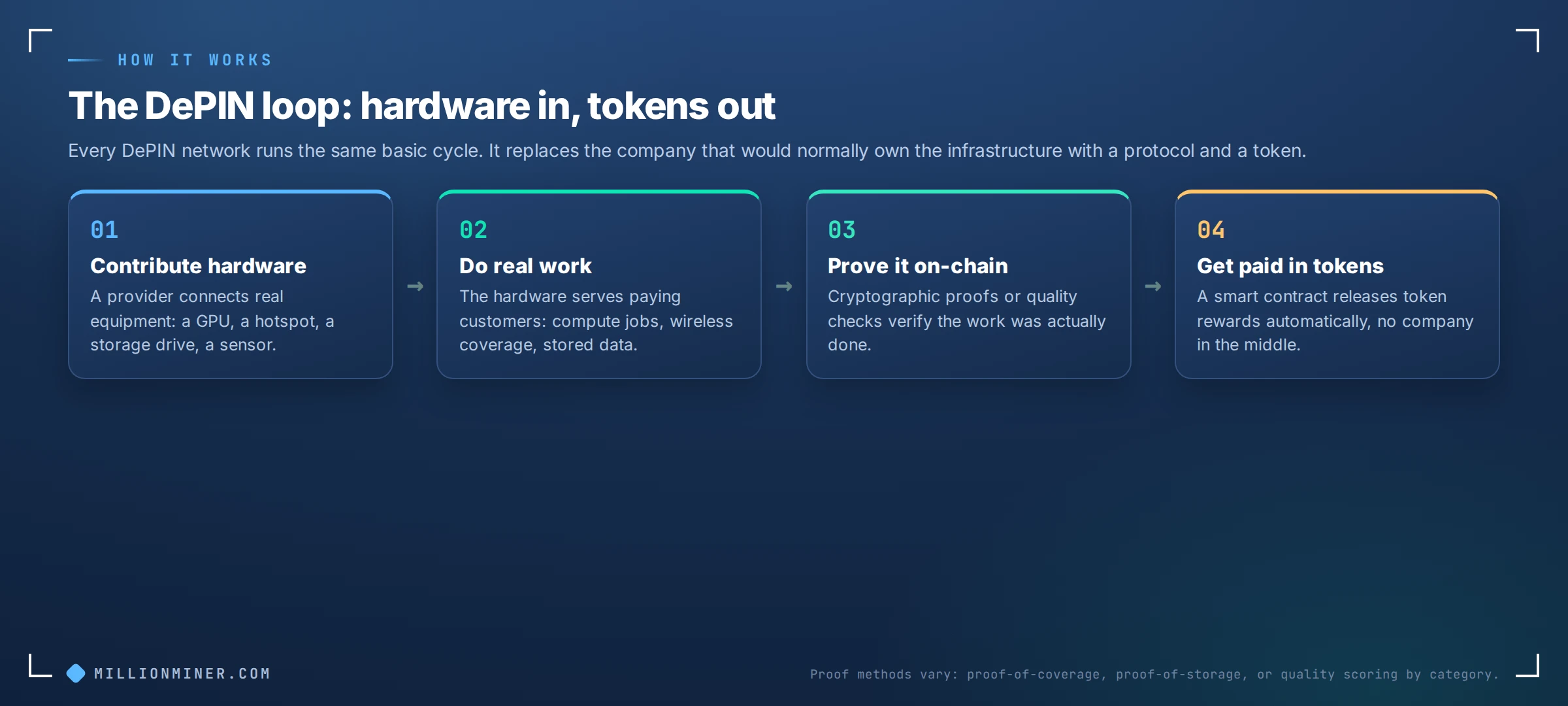
Before committing to a decentralized wireless provider, it helps to understand the underlying architecture and ownership models. These networks rely on distributed nodes rather than centralized towers, shifting both the technical and economic dynamics of internet access.
No comments yet. Be the first to share your thoughts!